
Fully loaded cost per agent hour: build the budget line by line
Build a fully loaded cost per agent hour from wage, taxes, benefits, overhead and supervision, then convert it to cost per productive hour and minute.
Read the guide
Compare in-house, onshore, nearshore and offshore contact centers by cost per resolved contact, billing model, hidden costs and contract terms.
Compare locations by cost per resolved contact, not by hourly rate. Cost per resolved contact = total monthly cost, including vendor fees, your own management, quality assurance and transition, divided by contacts that were actually resolved. A cheaper hourly rate can lose if handling time is longer or fewer contacts are resolved. Ask each vendor to quote under the same billing model and volume assumptions.
Part of our guide: Contact center software
The hourly rate is what a vendor charges for one hour of an agent's time. The productive-hour price is what you pay per hour actually spent handling contacts. Cost per resolved contact is the total you pay divided by the contacts that did not come back.
These three numbers can rank locations differently. A lower rate with longer handling time and more repeat contacts may cost more per resolution. We give no rate ranges for countries here, because published ranges vary by vendor, language and scope, and go stale. Get quotes.
Ask each vendor to state its resolution definition in the quote. If the vendor counts a contact as resolved when the call ends, and you count it only when the customer does not return within seven days, the two figures are not comparable. Agree the definition and the look-back window in writing before comparing.
The model decides who carries the risk of idle time and low productivity, so compare like with like.
Example of the risk split: at $30.00 per productive hour you pay for 1,166.67 hours whatever the volume mix. Under a per-FTE model with the same agent at, for instance, 60% occupancy, you would pay for the idle 40% too, so the equivalent hourly rate must be lower to match. Always convert every quote into cost per productive hour first.
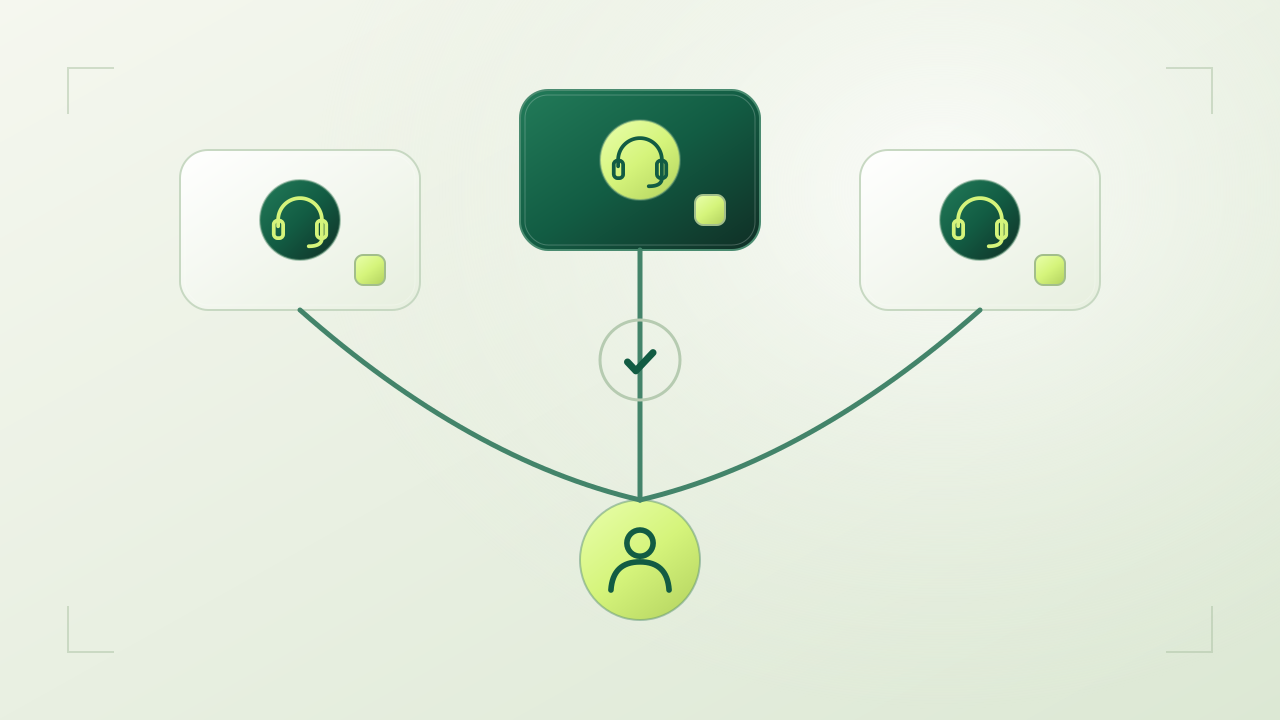
Rank options by cost per resolved contact, not by hourly rate.
Quotes seldom include everything you will pay. List these before comparing.
Do not let hidden costs sit in a footnote. Give each a monthly number, even a rough one, mark it as an estimate, and test the result with a range. If the answer flips inside a reasonable range, the decision depends on that assumption, and you should measure it in a pilot.
Assume 10,000 contacts a month. In-house: handling time 6 minutes, so 1,000 handling hours. Using the fully loaded productive-hour cost of $55.24 from our agent cost guide, agent cost is $55,237. Add $1,500 for quality assurance: $56,737, or $5.67 per contact. Assume 78% of contacts are resolved, which is 7,800. Cost per resolved contact = $7.27.
Vendor (example quote): $30.00 per productive hour, handling time 7 minutes (new process and language), so 1,166.67 hours = $35,000. Add $6,500 of your own vendor management, $1,500 quality assurance and a $20,000 transition fee spread over 24 months ($833). Total = $43,833, or $4.38 per contact. Assume 72% resolved, which is 7,200. Cost per resolved contact = $6.09.
The vendor wins in this example. But at 60.3% resolution (6,026 resolved contacts), the vendor equals the in-house cost of $7.27. Break-even resolution = vendor monthly cost ÷ (in-house cost per resolved contact × volume). The outsource comparison calculator tests your own numbers.
A second check: if the vendor handling time were 6 minutes, like in-house, its cost would be 1,000 hours × $30.00 = $30,000, and the total $38,833, or $5.39 per resolved contact at 72%. Handling time alone moves the result by $0.70 per resolved contact, so test it in the pilot.
Contract terms decide whether the modeled saving is real. This is general information, not legal advice; confirm with counsel for your jurisdictions.
Ask for references from clients with similar volume, language and complexity, and for the vendor's own attrition, absence and quality data for the proposed team, not company averages. Verify them in the pilot.
Send every vendor the same brief: volumes by hour, contact types, languages, handling times, systems and targets. Ask for a quote under at least two billing models. Build one sheet with all costs above, then compare cost per resolved contact at base, low and high resolution. Run a paid pilot of 8 to 12 weeks and measure with your own data before signing a long term.
Review the model after six months of live data. Replace the estimates for handling time, resolution and management hours with actuals, and renegotiate if the gap against the quote is large. Keep an internal baseline so you can still compare against in-house cost.
Include a no-regret scenario in your model: keeping the highest-complexity contacts in-house and outsourcing only routine ones. Many operations compare this split against the all-or-nothing options, because complex contacts are where resolution differences are largest.
No. Lower hourly rates can be offset by longer handling time, lower resolution, management overhead, attrition and transition costs. Compare total cost per resolved contact using your own volumes and the same billing model.
Nearshore means using a vendor in a nearby country, usually with a small time-zone difference and sometimes shared language or culture. The term has no fixed definition, so check what each vendor means.
Common models are per FTE, per productive hour, per minute and per resolved contact, or a hybrid with bonuses and penalties. Each splits risk differently, so ask for quotes under more than one.
Add vendor fees, your own management and quality costs, and amortized transition fees. Divide by the number of contacts resolved without a repeat. Define resolution first.
Processing instructions, security measures, subprocessor approval, breach notification, a lawful cross-border transfer mechanism, and deletion or return of data on exit. Confirm requirements with counsel for each jurisdiction.
Prepared by the ContactCenter.me editorial team, a BroadNet resource powered by DialerBee. Product statements reflect the linked documentation checked 2026-11-25. Operational examples are planning guidance. Read our editorial standards and commercial disclosure.
Compare the monthly and contract cost of running a team in-house with an outsourcer billed per productive hour.
Turn salary, payroll costs and overhead into the real cost per paid hour, productive hour and handled minute.
Calculate your blended contact cost and see what a change in volume would mean.
Build a fully loaded cost per agent hour from wage, taxes, benefits, overhead and supervision, then convert it to cost per productive hour and minute.
Read the guide
Understand the difference between call centers and contact centers, then map channels, ownership and reporting to your actual customer journeys.
Read the guide
Build a complete CCaaS cost model covering seats, carrier usage, AI, implementation, support and contract assumptions.
Read the guideExplore your requirements with a DialerBee specialist. Bring your workflows, your carrier, and your questions.