
Preview, power, progressive or predictive: choose the right dialing mode
Compare outbound dialing modes by preparation needs, agent readiness, list quality, customer experience and campaign controls.
Read the guide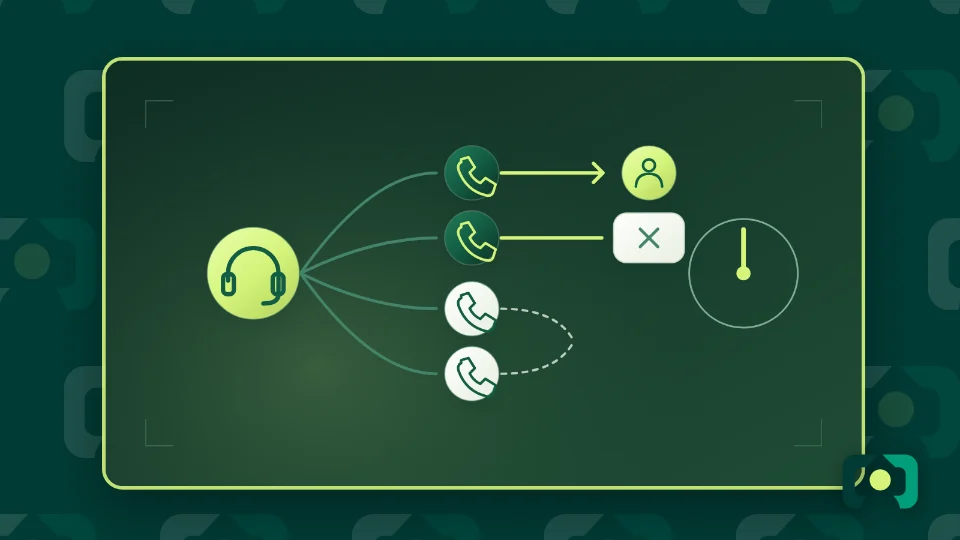
How predictive dialer pacing works, why fixed dial ratios over-dial, and how the FTC and FCC measure the 3% abandonment limit, with a worked model.
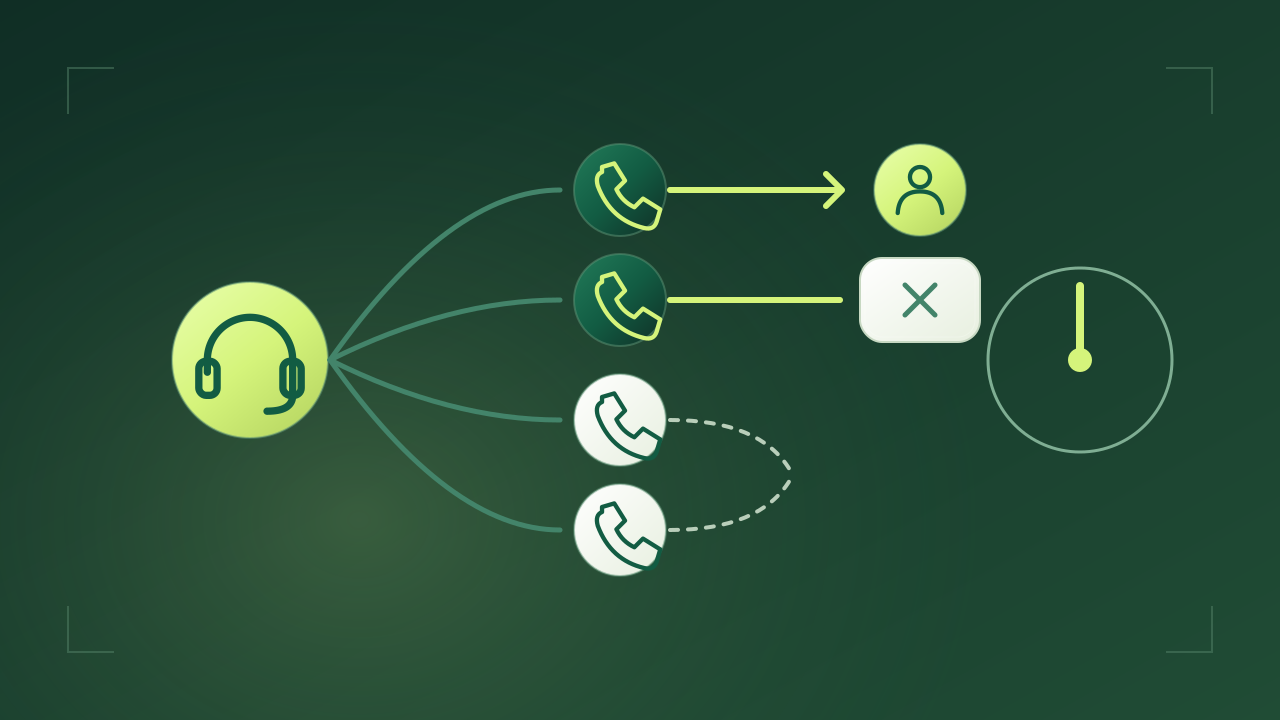
Dialer pacing is the number of lines a dialer calls for each agent who is free or about to be free. More lines per agent means less agent idle time but more answered calls with no agent ready. In the US, telemarketing campaigns may abandon no more than 3% of calls answered by a live person, measured per campaign over each 30-day period. A call is abandoned if no agent joins within 2 seconds of the person's completed greeting.
Part of our guide: Contact center software
The pacing ratio, also called the dial ratio, is the number of lines dialed for each available agent. A ratio of 3:1 means the dialer starts three calls for every free agent. The connect rate, or live-answer rate, is the share of dials that a person answers. Busy signals, no answers, disconnected numbers and answering machines are not live answers.
Pacing links the two numbers. Expected live answers per free agent = pacing ratio × connect rate. If the connect rate is 25% and the ratio is 3:1, each free agent can expect 0.75 live answers per dialing cycle. Below 1, agents wait. Above 1, some answered people find no agent and the call is abandoned.
Vendors use the dialing mode names differently. In general, preview dialing lets the agent see the record before one call is placed, progressive or power dialing places a fixed number of calls per free agent, and predictive dialing changes the number of calls automatically from live statistics. Check how your own dialer defines each mode before you compare settings.
A fixed ratio assumes the connect rate stays the same. It does not. Connect rates change by hour of day, by list source, by how often a list has already been called and by the time zone being dialed. A ratio that keeps agents busy on a fresh list in the morning can produce many abandoned calls when an evening list answers more often.
Team size matters too. With many free agents, the dialer pools random answers across agents, so a lucky burst on one line is absorbed by another agent. With one or two free agents there is no pooling, and the same ratio abandons a much larger share of calls. The worked example below shows the size of this effect.
Expected live answers per free agent equal the pacing ratio times the connect rate.
Two US federal rules cover abandoned telemarketing calls. The FTC's Telemarketing Sales Rule treats abandoning an outbound call as an abusive practice under 16 CFR 310.4(b)(1)(iv) and gives a safe harbor in 16 CFR 310.4(b)(4). The FCC's TCPA rule sets the limit directly in 47 CFR 64.1200(a)(6) and (a)(7). Many callers fall under both, so build one process that meets the stricter version of each element. This is general information about US federal rules as of November 2026, not legal advice; confirm your obligations with counsel.
The 3% numbers match, but the wording does not. The FTC denominator is "all calls answered by a person". The FCC denominator is "all telemarketing calls that are answered live by a person". In both, calls answered by an answering machine or voicemail are not live answers, so they stay out of the denominator.
The time window also differs slightly. The FTC measures over the whole campaign if it lasts less than 30 days, or separately over each 30-day period or part of one. The FCC measures over a 30-day period for a single campaign, and separately for each further 30-day period or part of one. Neither rule lets you average one campaign with another.
The FCC rule has two exceptions. A prerecorded telemarketing message sent with the person's prior express written consent is not abandoned if it starts within 2 seconds of the greeting. Calls by or for tax-exempt nonprofit organizations are not covered by the FCC abandonment paragraph.
Example. This simple model shows why ratios that look safe can fail. Assume each dialed line is answered live with probability p, independently. For one free agent and n lines dialed, the expected live answers are n × p. The agent can take one of them if at least one answers, which happens with probability 1 − (1 − p)^n. So expected abandoned calls = n × p − (1 − (1 − p)^n), and the abandonment rate = expected abandoned ÷ (n × p).
With p = 0.25 and one free agent: at n = 2, expected answers are 0.5, the chance of at least one answer is 0.4375, and expected abandoned calls are 0.0625, which is 12.5% of live answers. At n = 3, expected abandoned calls are 0.172, which is 22.9%. Both are far above 3%.
Now pool 10 free agents with the same p = 0.25. The abandoned calls are the answers above 10, averaged over the binomial distribution. Dialing 30 lines (3:1) gives 7.5 expected answers and an abandonment rate of about 2.5%. Dialing 32 lines gives about 3.7%. Dialing 40 lines (4:1) gives about 10.8%. A small change in ratio moves the rate across the limit.
The model is a snapshot. Real predictive dialers also forecast agents who will finish soon and model ring times, so their results differ. Use the model to see the direction and size of the risk, then confirm with your dialer's measured abandonment.
Do not wait for day 30. Track a running total for each campaign from its first day, and compare it with the allowance: allowed abandoned calls = 3% × live answers so far.
Example. On day 12 a campaign has 8,400 live answers and 231 abandoned calls. The rate is 231 ÷ 8,400 = 2.75%. The allowance so far is 3% × 8,400 = 252, so the headroom is 21 calls. If the next days run hotter, lower the ratio before the headroom is gone.
In FCC 25-76, adopted on October 28, 2025 and published in the Federal Register on December 5, 2025, the FCC asked for comment on whether to eliminate its 15-second or four-ring rule and its 3% abandonment rule. It said modern dialers may have made them unnecessary. As of November 2026 we found no final rule, and the eCFR text of 47 CFR 64.1200(a)(6) and (a)(7) still contains both rules.
The FCC proposal does not change the FTC's Telemarketing Sales Rule, which has its own abandonment safe harbor. Keep complying with both until a final rule says otherwise, and check the docket before changing your settings.
Pacing is a trade-off between agent idle time and customer experience. Start conservative and raise the ratio only when your measured abandonment leaves room. DialerBee describes preview, progressive, power and predictive dialing for agent-operated campaigns, with availability depending on the plan.
There is no single good ratio. It depends on your connect rate and how many agents are free. Divide 1 by the connect rate for a rough upper bound, then lower it until measured abandonment stays safely under 3%.
No. Both rules measure abandonment against calls answered by a live person, so answering machine and voicemail calls are outside the denominator. A live person held in silence for more than 2 seconds is an abandoned call.
No. It is measured per campaign over 30 days, or over the whole campaign if shorter, with each further 30-day period measured separately. Watching it daily is still wise, because one bad day can use the headroom.
The FTC and FCC abandonment rules apply to telemarketing calls. Informational calls such as reminders are outside these specific limits, but other rules, such as consent for prerecorded or artificial voice calls, can still apply. Confirm with counsel.
No, not as of November 2026. FCC 25-76 asked whether to remove it, but no final rule has been adopted. The FTC's separate safe harbor in the Telemarketing Sales Rule also still applies.
Prepared by the ContactCenter.me editorial team, a BroadNet resource powered by DialerBee. Product statements reflect the linked documentation checked 2026-11-25. Operational examples are planning guidance. Read our editorial standards and commercial disclosure.
Estimate abandoned calls, agent wait and connects per hour for a dial ratio before you run a campaign.
Estimate attempt volume, connected workload and daily agent requirements.
Calculate abandonment with a consistent short-call exclusion policy.

Compare outbound dialing modes by preparation needs, agent readiness, list quality, customer experience and campaign controls.
Read the guide
Move to a new contact-center platform while retaining your SIP carrier, with test calls, staged routing, ownership and a documented rollback.
Read the guide
Design an IVR around caller intent, useful routing, accessible prompts and reliable fallbacks rather than internal departments.
Read the guideExplore your requirements with a DialerBee specialist. Bring your workflows, your carrier, and your questions.